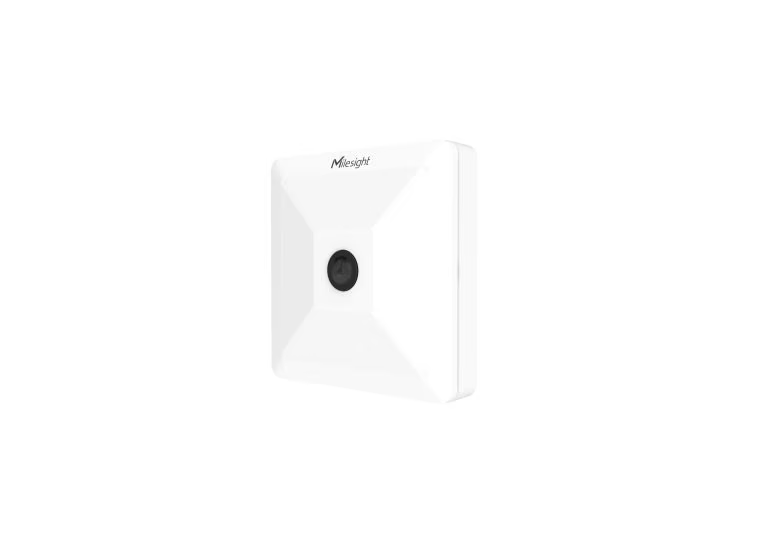
Milesight VS121 AI Workplace Occupancy Sensor
AI vision covering up to 127.84 m² across 16 user-defined regions, on LoRaWAN or PoE.
AUD $416.90 – AUD $585.20 inc. GST

Anonymous AI, millimetre-wave radar, and Passive Infrared (PIR) detection over LoRaWAN (Long Range Wide Area Network) on the AU915 band. Verified detection accuracy from desk level to whole-of-room coverage, with Australian stock and BMS integration support.
[ Request Trade Pricing ] [ Download Datasheets ]
[IMAGE ALT — Banner]: occupancy sensor — Qantec Automation Australia
SECTION 3 — CATEGORY INTRO
Qantec Automation, a sister company of Oberix Group [Link to: About Qantec Automation / Oberix Group Credentials Page], supplies and supports the complete Milesight occupancy sensor and presence sensor range across Australia. The category spans anonymous AI vision, 24GHz and 60GHz millimetre-wave radar, Time-of-Flight, and PIR detection, supplied as occupancy sensors for offices, meeting rooms, and restrooms, all reporting over LoRaWAN on the AU915 band or Power over Ethernet. Stock is held locally with trade pricing, AU915 firmware verification, and integration support aligned to the National Construction Code (NCC) and indoor environment ratings.
SECTION 4 — SUB-CATEGORY PRODUCTS
SECTION 5 — FEATURED PRODUCTS
SECTION 6 — CTA BAR
Send your meeting-room, desk, and restroom counts, and we will match occupancy sensors for offices, meeting rooms, and restrooms to coverage, mounting height, and AU915 LoRaWAN backhaul. Trade pricing and stock confirmation are available for project quantities.
[ Request Trade Pricing → ]
Australian-held stock · manufacturer warranty · returns accepted within policy · stock and lead time confirmed before dispatch · ABN [Sufyan/Abdullah: insert Qantec Automation ABN].
SECTION 7 — DETAILED CONTENT
On this page: Technology Overview · Sensor models by detection technology · Australian Compliance for Occupancy Sensors · Why Specify Qantec for Milesight Occupancy Sensors · Milesight Occupancy & Presence Sensor FAQ
An occupancy sensor reports whether a defined space is in use, while a presence sensor confirms a person remains present even when motionless. These workplace occupancy sensors scale from a single desk to whole-of-room coverage, and the table below compares detection technology, accuracy, and best-fit space. Specify them as a desk occupancy sensor, a room occupancy sensor, or a ceiling mounted presence sensor, with most models reporting on the AU915 LoRaWAN band.
| Detection Technology | Representative Model(s) | Typical Accuracy | Works in Darkness | Best-fit Space |
|---|---|---|---|---|
| AI vision | VS121, VS321 | up to 98% (VS321 up to 95%) | No (needs light) | Open-plan, multi-region |
| 24GHz radar + PIR | VS370 | up to 99% | Yes | Meeting rooms, stillness/presence |
| 60GHz 4D radar | VS373 | up to 99% | Yes | Aged care, fall + bed presence |
| ToF + PIR | VS330 | over 99.5% | Yes | Restrooms / cubicles |
| Thermopile + PIR | VS34X | up to 98% | Yes | Desks / seats |
| PIR + light | WS202 | — | Yes (PIR) | Lighting control |
| PIR + temp/humidity | WS203 | — | Yes (PIR) | Ventilation triggers |
Accuracy figures verified against Milesight datasheets — VS121, VS321, VS330, VS370, VS373, and VS34X (cited in each model section below).
This selector maps these workplace occupancy sensors — from a single desk occupancy sensor upward — to power, backhaul, and use case.
| Model | Detection | Power / Backhaul | Key spec | Use case |
|---|---|---|---|---|
| VS121 | AI vision (RGB) | LoRaWAN or PoE | 127.84 m², 16 regions | Open-plan, meeting rooms |
| VS321 | PIR + AI RGB | Battery, LoRaWAN / D2D | Ceiling mount, hot-desking | Workstations, meeting rooms |
| VS370 | 24GHz radar + PIR | Battery, LoRaWAN / D2D | 5-yr battery, works in dark | Meeting-room presence |
| VS373 | 60GHz 4D radar | Wi-Fi + LoRaWAN / D2D | Fall + bed presence | Aged care, accessible restrooms |
| VS330 | ToF + PIR | Battery, LoRaWAN | 0–75° probe, 4-yr battery | Restrooms, cubicles |
| VS34X | Thermopile + PIR | Battery, LoRaWAN | VS340/VS341, NFC config | Desks, seats |
| WS202 | PIR + light | Battery, LoRaWAN / D2D | Lux threshold, 6–8 m | Lighting control |
| WS203 | PIR + temp/humidity | Battery, LoRaWAN / D2D | 1,000 records, ~5-yr battery | Ventilation triggers |
This sub-category sits within the broader IoT sensors and devices range [Link to: IoT Sensors & Devices Main Category Page], alongside people counting sensors [Link to: People Counting Sensors Sub-Category Page] for entrance and footfall analytics.
The VS121 is a LoRaWAN or Power over Ethernet AI workplace occupancy sensor covering up to 127.84 m² across as many as 16 user-defined regions. On-device AI reaches up to 98% recognition (VS121 datasheet) while transmitting only anonymised occupancy values, so no images leave the unit. The LoRaWAN model joins a LoRaWAN gateway [Link to: LoRaWAN Gateway Sub-Category Page] on AU915. The VS121-P variant adds DI, DO, RS485, Building Automation and Control Network (BACnet/IP), and HTTP(S)/MQTT(S) for direct BACnet controller [Link to: BACnet Controllers Sub-Category Page] integration. It deploys as occupancy sensors for offices and large meeting rooms, and mounts as a ceiling mounted presence sensor for multi-region coverage.
The VS321 is a battery-powered wireless occupancy sensor and ceiling mounted presence sensor that pairs PIR triggering with an RGB camera and embedded AI for up to 95% accuracy (VS321 datasheet). PIR wakes the camera only on motion, extending battery life while AI confirms workstation-level and regional occupancy, making it a flexible desk occupancy sensor for hot-desking. Built-in light, temperature, and humidity sensing feeds automation. Milesight Device-to-Device (D2D) control, a LoRa-based peer-to-peer protocol, can drive lighting directly without a gateway.
The VS370 is a radar human presence sensor combining 24GHz millimetre-wave radar with PIR to detect stillness-level presence at up to 99% accuracy (VS370 datasheet). It operates in complete darkness, captures no images, and offers a magnetic bracket with a 30° deflection angle for full-area coverage. A five-year battery and D2D support make it a low-maintenance radar human presence sensor for meeting-room detection and automated room release.
The VS373 uses 4D 60GHz millimetre-wave radar with a MIMO array for non-contact fall detection at up to 99% accuracy (VS373 datasheet), plus room occupancy, bed presence, and motionless or over-stay alerts. A three-phase alarm logic of confirmation, first alert, and emergency alert reduces false positives in nursing homes, wards, and accessible restrooms. It supports Wi-Fi and LoRaWAN, and acts as a D2D controller for instant local response.
The VS330 is a bathroom occupancy sensor and toilet occupancy sensor that fuses ToF ranging with PIR for over 99.5% accuracy inside cubicles, per Milesight's published VS330 data. PIR triggers first, then ToF reconfirms at five-second intervals, keeping status updates prompt in high-traffic, low-capacity rooms. A rotatable 0–75° probe, a conformal-coated PCB for damp environments, and a four-year battery suit restroom and meeting-booth deployments. Order via the bathroom occupancy sensor product page [Link to: Milesight VS330 Bathroom Occupancy Sensor Product Page].
The VS34X series is a desk occupancy sensor and seat occupancy sensor for workstation-level monitoring, offered as the VS340 with PIR and the VS341 with PIR plus thermopile infrared. Sensor fusion delivers up to 98% accuracy (VS34X product page), distinguishing an occupied seat from a vacated one for hot-desking and space analytics. Both variants run on AU915 LoRaWAN with NFC configuration for fast rollout across open-plan floors.
The WS202 is a PIR occupancy sensor with an integrated light sensor, detecting motion within 6 to 8 metres and reporting a bright or dark threshold. Paired with WS50x wall switches or the WS558 controller over D2D, it automates smart lighting control [Link to: Smart Controls & Switches Sub-Category Page] without gateway latency. At 50 × 50 × 23.8 mm with CE, FCC, RoHS, and LoRaWAN certification, it installs on flat surfaces by screw or adhesive tape.
The WS203 is a motion occupancy sensor with built-in temperature and humidity readings, covering 120° horizontal and 100° vertical PIR within 6 metres. It logs up to 1,000 timestamped records with retransmission after dropouts, and a 4000 mAh ER18505 cell gives roughly five years of service. Via D2D it can trigger ventilation in under one second through a UC300 IoT controller [Link to: IOT Controllers Sub-Category Page], supporting demand-controlled airflow alongside smart room sensors [Link to: Smart Room Sensors & Controls Sub-Category Page].
Occupancy and presence data is the trigger layer for compliant lighting, ventilation, and indoor environment outcomes in Australian buildings. The National Construction Code (NCC) Section J recognises occupancy and motion detection as a lighting-control method, and AS 1668.2 underpins demand-controlled mechanical ventilation driven by real occupancy.
Because radar, ToF, and PIR detection capture no images, deployments align with the Australian Privacy Principles under the Privacy Act 1988, and the VS121 and VS321 process anonymised RGB data on-device. For lone-occupant areas, VS373 fall detection supports Work Health and Safety Act 2011 duty-of-care obligations. Occupancy-linked control also contributes to National Australian Built Environment Rating System (NABERS) Indoor Environment outcomes — see the NABERS framework — and Green Star Buildings v1.1 credits.
| Compliance Driver | Relevant Framework | Sensor Function |
|---|---|---|
| Lighting power reduction | NCC Volume One Section J | PIR or occupancy switching of lighting in intermittent spaces |
| Demand-controlled ventilation | AS 1668.2 | Occupancy-linked airflow modulation |
| Indoor environment quality | NABERS IE / Green Star Buildings v1.1 | Real occupancy data for comfort and ventilation response |
| Privacy of building users | Privacy Act 1988 (APPs) | Non-imaging radar/ToF/PIR; anonymised on-device AI |
| Lone-occupant duty of care | WHS Act 2011 | VS373 fall and motionless detection in accessible restrooms |
Qantec Automation supplies the Milesight occupancy sensor range with local stock, verified AU915 firmware, and engineering support for Australian BMS projects.
The VS121-P exposes the largest attack surface in this range through its IP interfaces, so segment it onto a dedicated VLAN isolated from corporate traffic and reach it for management only across a VPN tunnel. Enforce per-user access controls and change default credentials on first NFC or web configuration. Encrypt telemetry in transit using HTTPS and MQTTS rather than plain MQTT, and restrict BACnet/IP to the building network. Apply signed firmware updates from Milesight to maintain firmware integrity, and record firmware versions during commissioning so field units can be audited against known-good baselines.
What mounting height suits a ceiling mounted presence sensor?
Mounting height depends on the model. The VS330 bathroom occupancy sensor installs at 2.5 to 3 metres directly above the cubicle, while the VS121 covers up to 127.84 m² from a ceiling position. Radar units such as the VS370 use an adjustable 30° bracket to fine-tune coverage at typical ceiling heights.
How many occupancy sensors fit on one gateway?
Capacity is set by uplink frequency and gateway channel plan, not a fixed device cap. On AU915 with Class A sensors reporting at intervals of several minutes, a single Milesight gateway commonly serves hundreds of nodes. Stagger reporting intervals and apply Adaptive Data Rate to protect airtime as the network scales.
Which occupancy sensor works in a completely dark room?
Radar and PIR detection are independent of light, so the VS370 radar human presence sensor and the WS202 PIR occupancy sensor operate in full darkness. AI vision models such as the VS121 and VS321 depend on adequate illuminance, so verify lux levels before specifying them for unlit spaces.
Can occupancy sensors trigger lighting without a gateway?
Yes. Milesight D2D is a LoRa-based peer-to-peer link that lets a WS202 or VS321 command a WS50x wall switch or WS558 controller directly, with sub-second latency and no gateway dependency. A gateway is still required if the same data must reach a BMS or cloud platform.
SECTION 8 — FOOTER CTA
Qantec Automation holds AU915 stock, verifies firmware, and helps engineers deploy workplace occupancy sensors across LoRaWAN and Power over Ethernet into BACnet/IP head-ends. Send a floor plan or a bill of materials, and we will confirm models, coverage, and lead times for your project.
[ Request Trade Pricing ] [ Download Datasheets ] [ Book an Engineering Call ]
Australian-held stock · manufacturer warranty · returns within policy · stock and lead time confirmed before dispatch.
SECTION 9 — EXTENDED FAQ
Can a radar presence sensor detect people in the next room or adjacent cubicle?
Yes. 24GHz and 60GHz millimetre-wave radar passes through plasterboard, glass, and partitions, so an over-sensitive unit can register movement in an adjacent space. The VS370 and VS373 counter this with adjustable sensitivity and customisable detection-free zones that mask areas beyond the intended room. Set the zone boundary inside the physical wall line and reduce radar sensitivity during commissioning to remove cross-room false positives.
[DEVELOPER NOTE: Sourced from high-visibility PAA. Sufyan, embed this verified video URL: https://www.youtube.com/watch?v=Lz7RdYlSIBk and apply VideoObject Schema per technical standards]
Why do lights switch off while someone sits still under a PIR occupancy sensor?
PIR detects changing infrared from motion, so a motionless occupant stops triggering it and the controller times out. A radar human presence sensor such as the VS370 resolves this by sensing micro-movements like breathing, while the VS330 uses Time-of-Flight ranging to confirm a static occupant by distance. For seated, low-motion areas, specify radar or ToF rather than PIR alone.
[DEVELOPER NOTE: Sourced from high-visibility PAA. Sufyan, embed this verified video URL: https://www.youtube.com/watch?v=1__xXMjaQa4 and apply VideoObject Schema per technical standards]
What LoRaWAN device class do these sensors use, and how does it affect remote control?
All units operate as LoRaWAN Class A, where each sensor sends an uplink and then opens two short receive windows for any downlink. Downlink commands such as threshold changes or reboots are queued and delivered only after the next uplink, never on demand. Plan reporting intervals accordingly, and use Milesight D2D for the sub-second local control that Class A downlinks cannot provide.
How do I integrate occupancy data into a BACnet/IP building management system?
The VS121-P exposes native BACnet/IP objects over its Ethernet port, so it maps directly into a BACnet head-end. Battery and LoRaWAN-only sensors instead reach the network server, then bridge to BACnet through a gateway or an IoT controller [Link to: IOT Controllers Sub-Category Page] using MQTT or HTTP. Confirm object naming and instance numbers during commissioning to keep points consistent across the BMS.
What LoRaWAN range can I expect inside a multi-storey building?
Indoor range is typically tens of metres per floor rather than the kilometre figures quoted over open ground, because concrete slabs and steel heavily attenuate 915 MHz signals. The network compensates by raising the spreading factor, which extends reach but lengthens airtime and draws more battery per uplink. Position a gateway per floor or riser, and enable Adaptive Data Rate so nearby sensors use lower spreading factors and conserve battery.
How is the uplink payload from a Milesight occupancy sensor decoded?
Milesight publishes a payload decoder for each model, usually a JavaScript function loaded into the network server on the default uplink port 85. The decoder converts the raw byte stream into named fields such as occupancy status, illuminance, and battery level. Use the model-specific decoder on ChirpStack, The Things Stack, or your own platform rather than parsing bytes manually, since field order differs between models.
What battery life and chemistry should I plan for?
Most units run on a Lithium-Thionyl Chloride (Li-SOCl2) cell. The WS203 uses a 4000 mAh ER18505 for roughly five years, while the VS330 delivers a minimum of four years under its PIR-then-ToF logic. Cold and heat both reduce usable capacity, so derate expectations for plant rooms or external restrooms, and replace cells as a set across a floor to keep maintenance cycles predictable.
Should I commission these sensors with OTAA or ABP?
Use Over-the-Air Activation (OTAA) for managed networks, because it negotiates fresh session keys at each join and is more secure than the static keys of Activation by Personalisation (ABP). Both modes are supported across the range. Whichever you select, change the default application and device keys before deployment, since published defaults offer no protection.
Do radar sensors that detect breathing create obligations under the Privacy Act 1988?
Radar detection captures no images or identifiable features, so it stays anonymous even when sensing respiration, and the VS373 reports only events such as a fall or an abnormal breathing rate. In healthcare and aged-care settings the resulting data can still be health information, so handle it under the Australian Privacy Principles of the Privacy Act 1988. Restrict access, encrypt storage, and document retention as part of commissioning.
SECTION 10 — SCHEMA IMPLEMENTATION NOTES
Apply three JSON-LD blocks in the page <head>. Populate live product URLs from WooCommerce.
FAQPage must include ALL unique Q&As from Section 7 (4) and Section 9 (9) = 13 entries, with
NO duplicate questions. Attach a VideoObject for each verified video.
1) ItemList - product grid (8 SKUs)
{
"@context": "https://schema.org",
"@type": "ItemList",
"name": "Occupancy & Presence Sensors",
"itemListElement": [
{ "@type": "ListItem", "position": 1, "name": "Milesight VS121 AI Workplace Occupancy Sensor", "url": "https://qantecautomation.com/product/milesight-vs121/" },
{ "@type": "ListItem", "position": 2, "name": "Milesight VS321 Wireless AI Occupancy Sensor", "url": "https://qantecautomation.com/product/milesight-vs321/" },
{ "@type": "ListItem", "position": 3, "name": "Milesight VS370 Radar Human Presence Sensor", "url": "https://qantecautomation.com/product/milesight-vs370/" },
{ "@type": "ListItem", "position": 4, "name": "Milesight VS373 Radar Fall Detection Sensor", "url": "https://qantecautomation.com/product/milesight-vs373/" },
{ "@type": "ListItem", "position": 5, "name": "Milesight VS330 Bathroom Occupancy Sensor", "url": "https://qantecautomation.com/product/milesight-vs330/" },
{ "@type": "ListItem", "position": 6, "name": "Milesight VS34X Desk & Seat Occupancy Sensor", "url": "https://qantecautomation.com/product/milesight-vs34x/" },
{ "@type": "ListItem", "position": 7, "name": "Milesight WS202 PIR & Light Sensor", "url": "https://qantecautomation.com/product/milesight-ws202/" },
{ "@type": "ListItem", "position": 8, "name": "Milesight WS203 Motion & TH Sensor", "url": "https://qantecautomation.com/product/milesight-ws203/" }
]
}
2) FAQPage - all 13 unique Q&As (Section 7 + Section 9); each answer matches the visible page
{
"@context": "https://schema.org",
"@type": "FAQPage",
"mainEntity": [
{ "@type": "Question", "name": "What mounting height suits a ceiling mounted presence sensor?",
"acceptedAnswer": { "@type": "Answer", "text": "Mounting height depends on the model. The VS330 bathroom occupancy sensor installs at 2.5 to 3 metres directly above the cubicle, while the VS121 covers up to 127.84 m² from a ceiling position. Radar units such as the VS370 use an adjustable 30° bracket to fine-tune coverage at typical ceiling heights." } },
{ "@type": "Question", "name": "How many occupancy sensors fit on one gateway?",
"acceptedAnswer": { "@type": "Answer", "text": "Capacity is set by uplink frequency and gateway channel plan, not a fixed device cap. On AU915 with Class A sensors reporting at intervals of several minutes, a single Milesight gateway commonly serves hundreds of nodes. Stagger reporting intervals and apply Adaptive Data Rate to protect airtime as the network scales." } },
{ "@type": "Question", "name": "Which occupancy sensor works in a completely dark room?",
"acceptedAnswer": { "@type": "Answer", "text": "Radar and PIR detection are independent of light, so the VS370 radar human presence sensor and the WS202 PIR occupancy sensor operate in full darkness. AI vision models such as the VS121 and VS321 depend on adequate illuminance, so verify lux levels before specifying them for unlit spaces." } },
{ "@type": "Question", "name": "Can occupancy sensors trigger lighting without a gateway?",
"acceptedAnswer": { "@type": "Answer", "text": "Yes. Milesight D2D is a LoRa-based peer-to-peer link that lets a WS202 or VS321 command a WS50x wall switch or WS558 controller directly, with sub-second latency and no gateway dependency. A gateway is still required if the same data must reach a BMS or cloud platform." } },
{ "@type": "Question", "name": "Can a radar presence sensor detect people in the next room or adjacent cubicle?",
"acceptedAnswer": { "@type": "Answer", "text": "Yes. 24GHz and 60GHz millimetre-wave radar passes through plasterboard, glass, and partitions, so an over-sensitive unit can register movement in an adjacent space. The VS370 and VS373 counter this with adjustable sensitivity and customisable detection-free zones that mask areas beyond the intended room. Set the zone boundary inside the physical wall line and reduce radar sensitivity during commissioning to remove cross-room false positives." } },
{ "@type": "Question", "name": "Why do lights switch off while someone sits still under a PIR occupancy sensor?",
"acceptedAnswer": { "@type": "Answer", "text": "PIR detects changing infrared from motion, so a motionless occupant stops triggering it and the controller times out. A radar human presence sensor such as the VS370 resolves this by sensing micro-movements like breathing, while the VS330 uses Time-of-Flight ranging to confirm a static occupant by distance. For seated, low-motion areas, specify radar or ToF rather than PIR alone." } },
{ "@type": "Question", "name": "What LoRaWAN device class do these sensors use, and how does it affect remote control?",
"acceptedAnswer": { "@type": "Answer", "text": "All units operate as LoRaWAN Class A, where each sensor sends an uplink and then opens two short receive windows for any downlink. Downlink commands such as threshold changes or reboots are queued and delivered only after the next uplink, never on demand. Plan reporting intervals accordingly, and use Milesight D2D for the sub-second local control that Class A downlinks cannot provide." } },
{ "@type": "Question", "name": "How do I integrate occupancy data into a BACnet/IP building management system?",
"acceptedAnswer": { "@type": "Answer", "text": "The VS121-P exposes native BACnet/IP objects over its Ethernet port, so it maps directly into a BACnet head-end. Battery and LoRaWAN-only sensors instead reach the network server, then bridge to BACnet through a gateway or an IoT controller [Link to: IOT Controllers Sub-Category Page] using MQTT or HTTP. Confirm object naming and instance numbers during commissioning to keep points consistent across the BMS." } },
{ "@type": "Question", "name": "What LoRaWAN range can I expect inside a multi-storey building?",
"acceptedAnswer": { "@type": "Answer", "text": "Indoor range is typically tens of metres per floor rather than the kilometre figures quoted over open ground, because concrete slabs and steel heavily attenuate 915 MHz signals. The network compensates by raising the spreading factor, which extends reach but lengthens airtime and draws more battery per uplink. Position a gateway per floor or riser, and enable Adaptive Data Rate so nearby sensors use lower spreading factors and conserve battery." } },
{ "@type": "Question", "name": "How is the uplink payload from a Milesight occupancy sensor decoded?",
"acceptedAnswer": { "@type": "Answer", "text": "Milesight publishes a payload decoder for each model, usually a JavaScript function loaded into the network server on the default uplink port 85. The decoder converts the raw byte stream into named fields such as occupancy status, illuminance, and battery level. Use the model-specific decoder on ChirpStack, The Things Stack, or your own platform rather than parsing bytes manually, since field order differs between models." } },
{ "@type": "Question", "name": "What battery life and chemistry should I plan for?",
"acceptedAnswer": { "@type": "Answer", "text": "Most units run on a Lithium-Thionyl Chloride (Li-SOCl2) cell. The WS203 uses a 4000 mAh ER18505 for roughly five years, while the VS330 delivers a minimum of four years under its PIR-then-ToF logic. Cold and heat both reduce usable capacity, so derate expectations for plant rooms or external restrooms, and replace cells as a set across a floor to keep maintenance cycles predictable." } },
{ "@type": "Question", "name": "Should I commission these sensors with OTAA or ABP?",
"acceptedAnswer": { "@type": "Answer", "text": "Use Over-the-Air Activation (OTAA) for managed networks, because it negotiates fresh session keys at each join and is more secure than the static keys of Activation by Personalisation (ABP). Both modes are supported across the range. Whichever you select, change the default application and device keys before deployment, since published defaults offer no protection." } },
{ "@type": "Question", "name": "Do radar sensors that detect breathing create obligations under the Privacy Act 1988?",
"acceptedAnswer": { "@type": "Answer", "text": "Radar detection captures no images or identifiable features, so it stays anonymous even when sensing respiration, and the VS373 reports only events such as a fall or an abnormal breathing rate. In healthcare and aged-care settings the resulting data can still be health information, so handle it under the Australian Privacy Principles of the Privacy Act 1988. Restrict access, encrypt storage, and document retention as part of commissioning." } }
]
}
3) VideoObject - one per verified asset
{
"@context": "https://schema.org",
"@type": "VideoObject",
"name": "Milesight VS370 Radar Human Presence Sensor for Meeting Rooms",
"description": "Radar human presence detection for meeting room occupancy and automated room release.",
"thumbnailUrl": "https://i.ytimg.com/vi/Lz7RdYlSIBk/hqdefault.jpg",
"uploadDate": "2025-04-17",
"contentUrl": "https://www.youtube.com/watch?v=Lz7RdYlSIBk",
"embedUrl": "https://www.youtube.com/embed/Lz7RdYlSIBk"
}
{
"@context": "https://schema.org",
"@type": "VideoObject",
"name": "Milesight VS330 LoRaWAN Bathroom/Restroom Occupancy Sensor",
"description": "ToF and PIR cubicle occupancy detection for high-traffic public restrooms.",
"thumbnailUrl": "https://i.ytimg.com/vi/1__xXMjaQa4/hqdefault.jpg",
"uploadDate": "2023-03-06",
"contentUrl": "https://www.youtube.com/watch?v=1__xXMjaQa4",
"embedUrl": "https://www.youtube.com/embed/1__xXMjaQa4"
}
OPTIONAL: add BreadcrumbList (Home > IoT Sensors & Devices > Occupancy & Presence Sensors).
4) Person - reviewer/author (reference as BOTH author and reviewedBy on the page WebPage/Article)
{
"@context": "https://schema.org",
"@type": "Person",
"name": "Dr. Abhishek Mitra",
"honorificPrefix": "Dr.",
"honorificSuffix": "PhD",
"jobTitle": "Business Development Manager, NSW",
"email": "a.mitra@qantecautomation.com",
"knowsAbout": "IoT Devices",
"alumniOf": { "@type": "EducationalOrganization", "name": "PhD in IoT Devices" },
"worksFor": { "@type": "Organization", "name": "Qantec Automation" },
"address": { "@type": "PostalAddress", "addressCountry": "AU" }
}
Showing 8 of 8 Products
AI vision covering up to 127.84 m² across 16 user-defined regions, on LoRaWAN or PoE.
AUD $416.90 – AUD $585.20 inc. GST
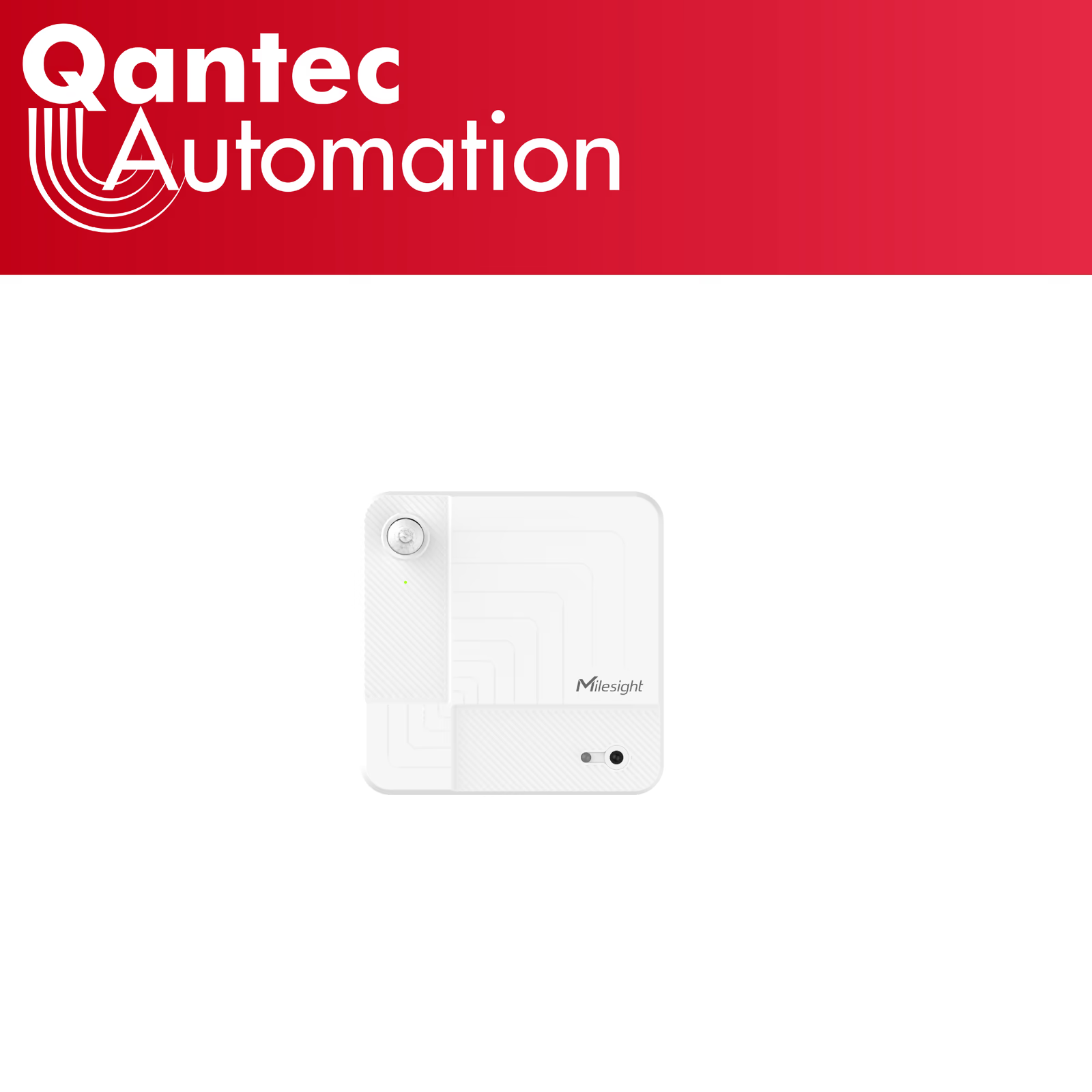
Ceiling-mounted battery sensor pairing PIR triggering with an RGB camera and on-board AI, to 95% accuracy.
AUD $196.90 inc. GST
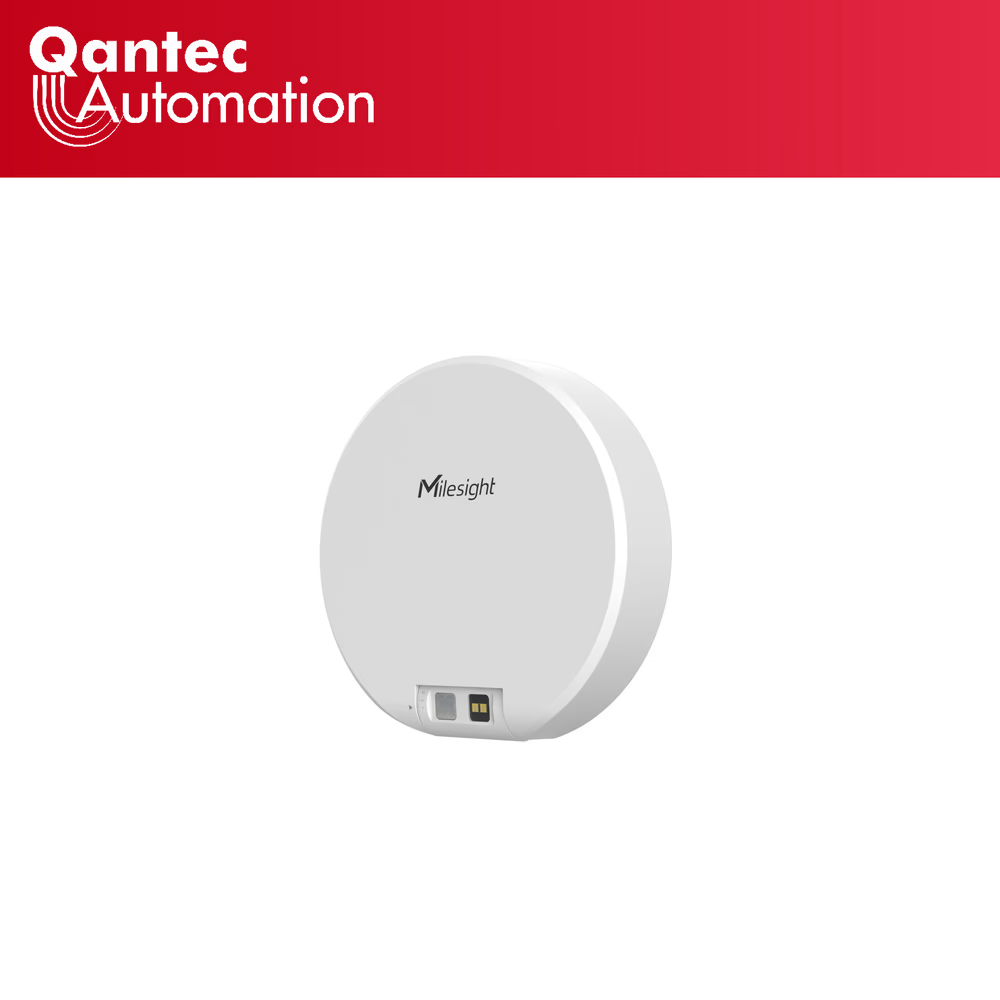
Introducing the VS330, a cutting-edge LoRaWAN® bathroom occupancy sensor that redefines public toilet monitoring By…
AUD $146.30 inc. GST
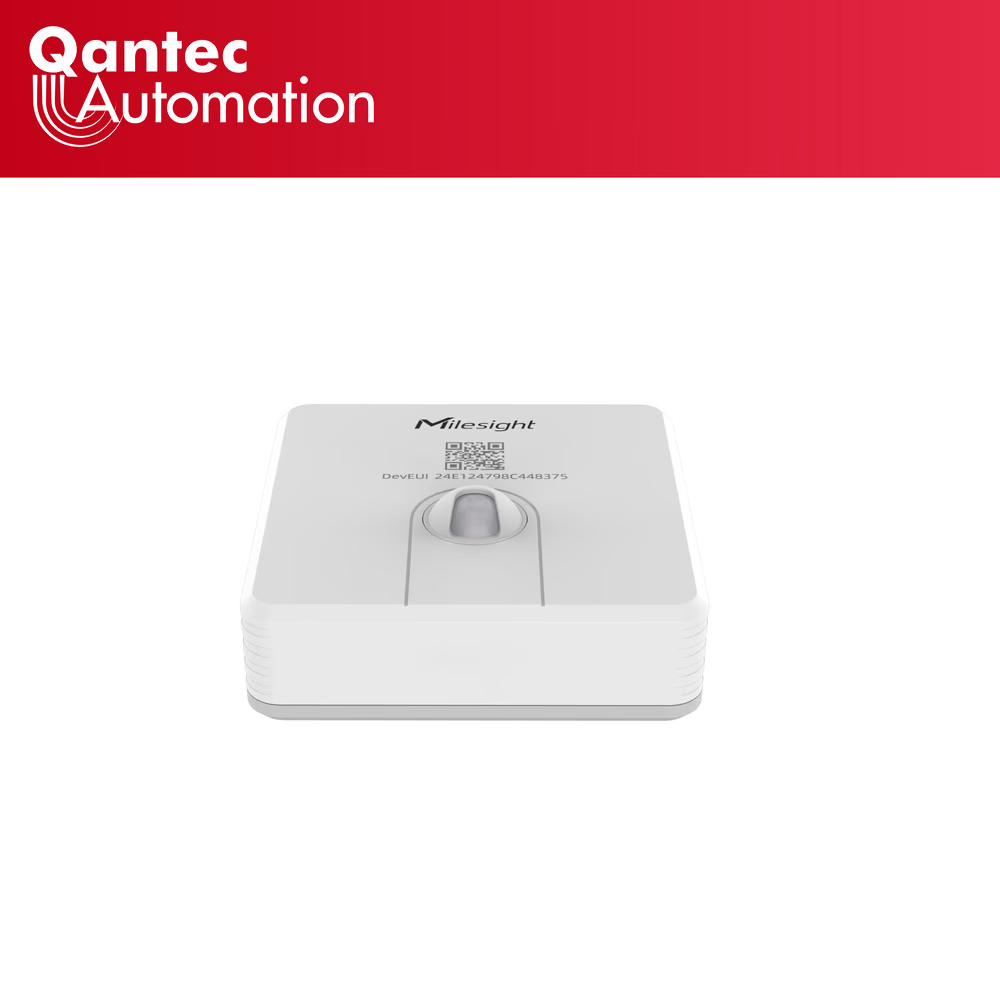
Workstation-level monitoring — the VS340 with PIR, the VS341 adding thermopile infrared.
AUD $94.60 – AUD $117.70 inc. GST
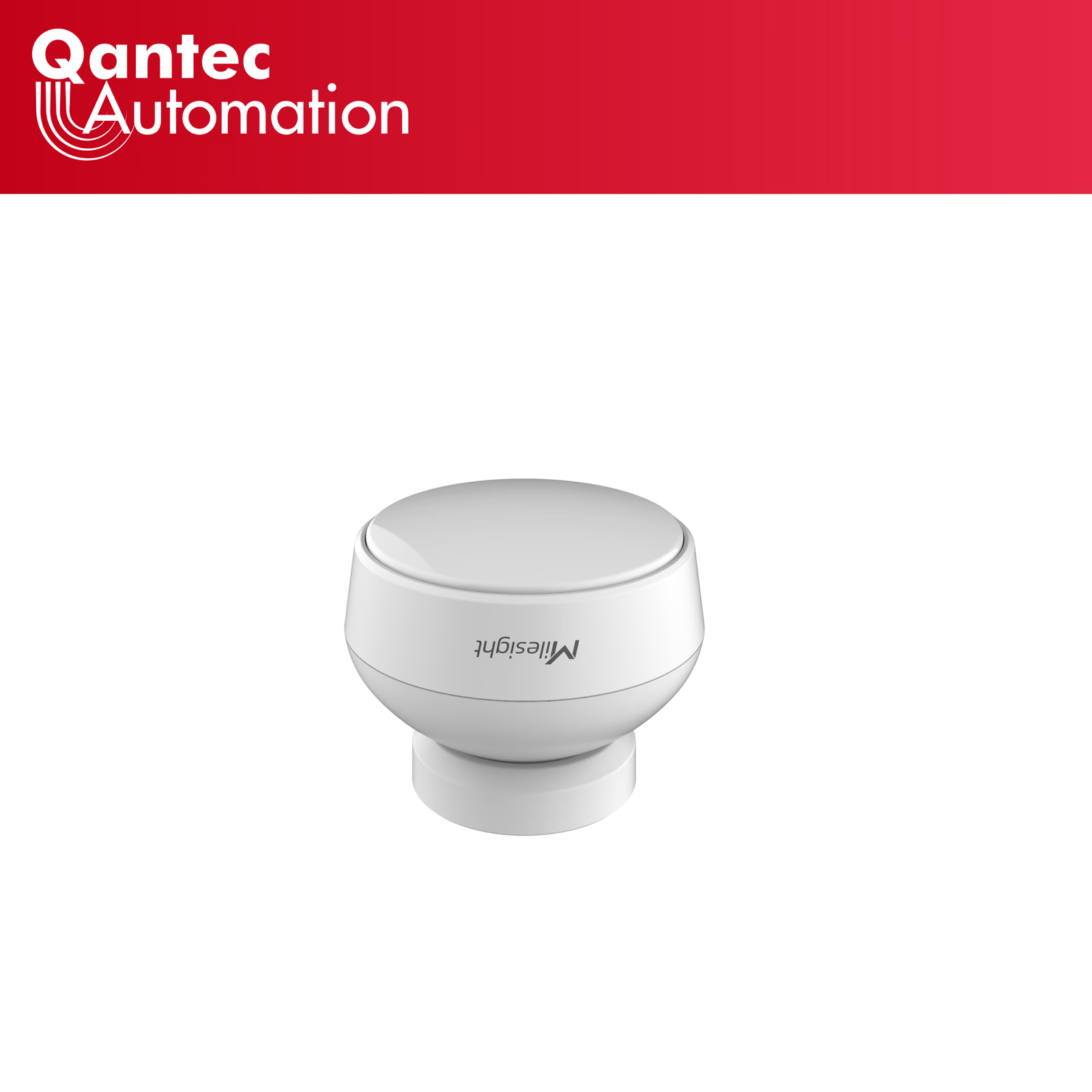
The Milesight VS370 is an essential component for modern smart solutions. .
AUD $147.40 inc. GST
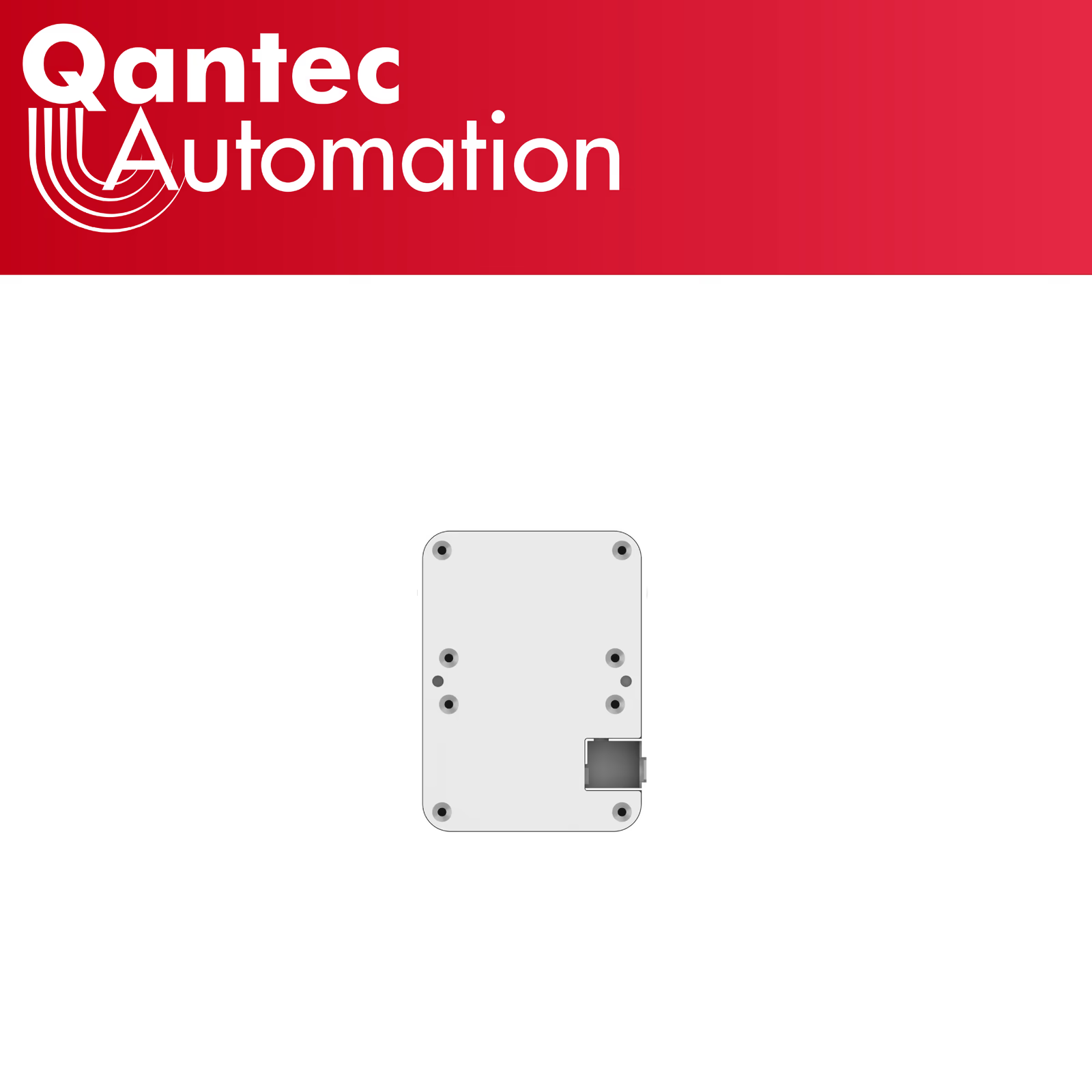
The Milesight VS373 is a cutting-edge solution designed to provide real-time monitoring Offering rapid response in…
AUD $424.60 inc. GST
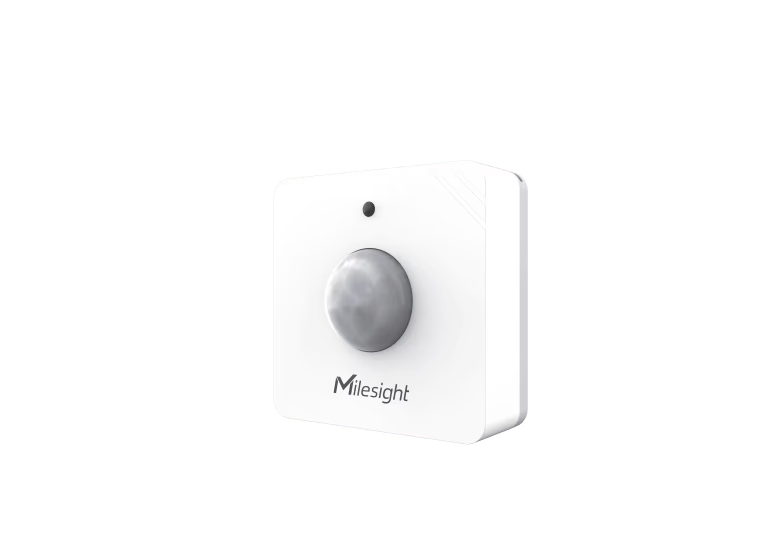
Passive infrared sensor technology The Milesight WS202 PIR & Light Sensor leverages advanced passive infrared sensor…
AUD $68.20 inc. GST
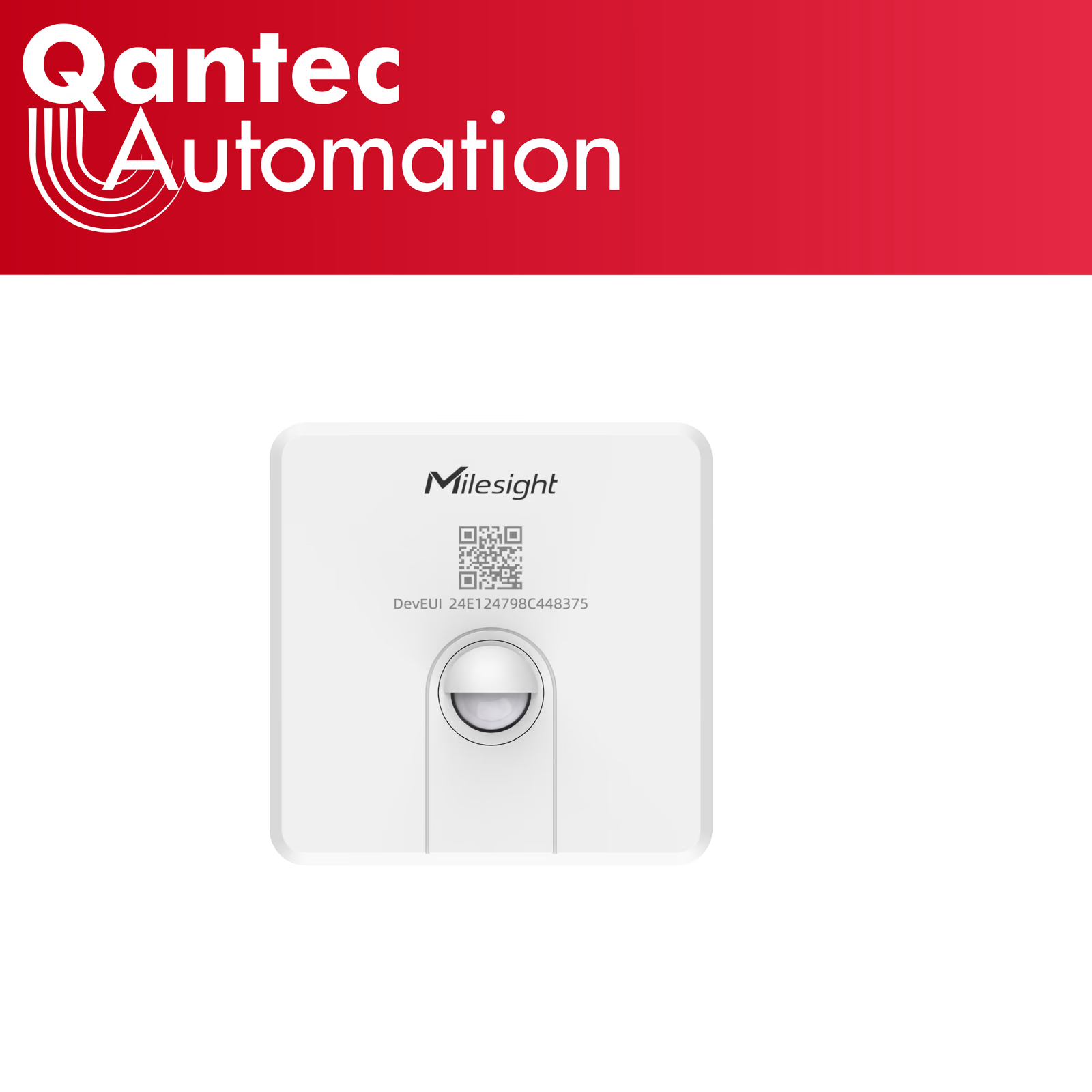
Discover Enhanced Motion Sensing with the Milesight WS203 Monitoring System Introducing the Milesight WS203, a…
AUD $84.70 inc. GST