IoT Product Accessories for Smart Buildings
Qantec Automation supplies the IoT product accessories that complete BACnet (Building Automation and Control network) and LoRaWAN (Long Range Wide Area Network) field deployments. These IoT product accessories — antennas, solar panels, field testers, probes and DIN rail power supplies — are verified against manufacturer datasheets and held in Australian stock.
*[Image Alt Text — Category Banner]: IoT Product Accessories — Qantec Automation Australia*
Category Intro Block
Qantec Automation is the Australian distribution arm of the Oberix Group, supplying Milesight and ABB Cylon hardware to systems integrators, BMS engineers and facility managers. This category consolidates the supporting IoT product accessories — RF antennas, photovoltaic panels, uninterruptible power supplies, field commissioning tools, temperature probes and field-level power and mounting hardware — that connect, power and validate sensing and control infrastructure. These IoT product accessories carry local Australian stock, trade pricing and direct engineering support from a team that specifies them on live projects across both the Milesight and ABB Cylon ranges.
Products in This Category
The thirteen IoT product accessories below are held in Australian stock and matched to specific Milesight and ABB Cylon hardware.
(WooCommerce tile rendering — sub-category mapping returns "Not Applicable", so products display directly.)
Featured Products Carousel
CTA Bar
Specifying the right IoT product accessories starts with your topology, so send the model numbers before you commit a purchase order.
Need The Right Accessory Specified Before Tender?
Send us the controller, gateway or sensor model and our engineers will confirm exactly which antenna, power supply or probe matches your topology. Trade accounts unlock volume pricing and priority dispatch from Australian stock.
Detailed Content
On this page: Field Tester & Antennas · Solar & Backup Power · Probes & Configuration Tools · Air Pressure Switches · ABB Power & Mounting · Australian Compliance · Why Qantec · FAQ
IoT Product Accessories Built for Integrators
IoT product accessories are the supporting hardware — antennas, solar panels, field testers, power supplies, probes and mounting components — that connect, energise, validate and protect field-level sensing and control devices. Across an Australian deployment, these IoT product accessories must satisfy local radio-frequency allocation (the AU915 sub-band, 915–928 MHz under the ACMA Low Interference Potential Devices Class Licence), ingress protection to IP65/IP67, and 35 mm top-hat DIN rail mounting per IEC 60715. Selecting the correct accessory is rarely cosmetic; an under-gained antenna or undersized power rail will surface as packet loss or brown-outs months after commissioning. The range below pairs Milesight wireless hardware with ABB Cylon field infrastructure so integrators can source both families of IoT product accessories from one Australian supplier.
LoRaWAN Field Tester and Antenna Accessories
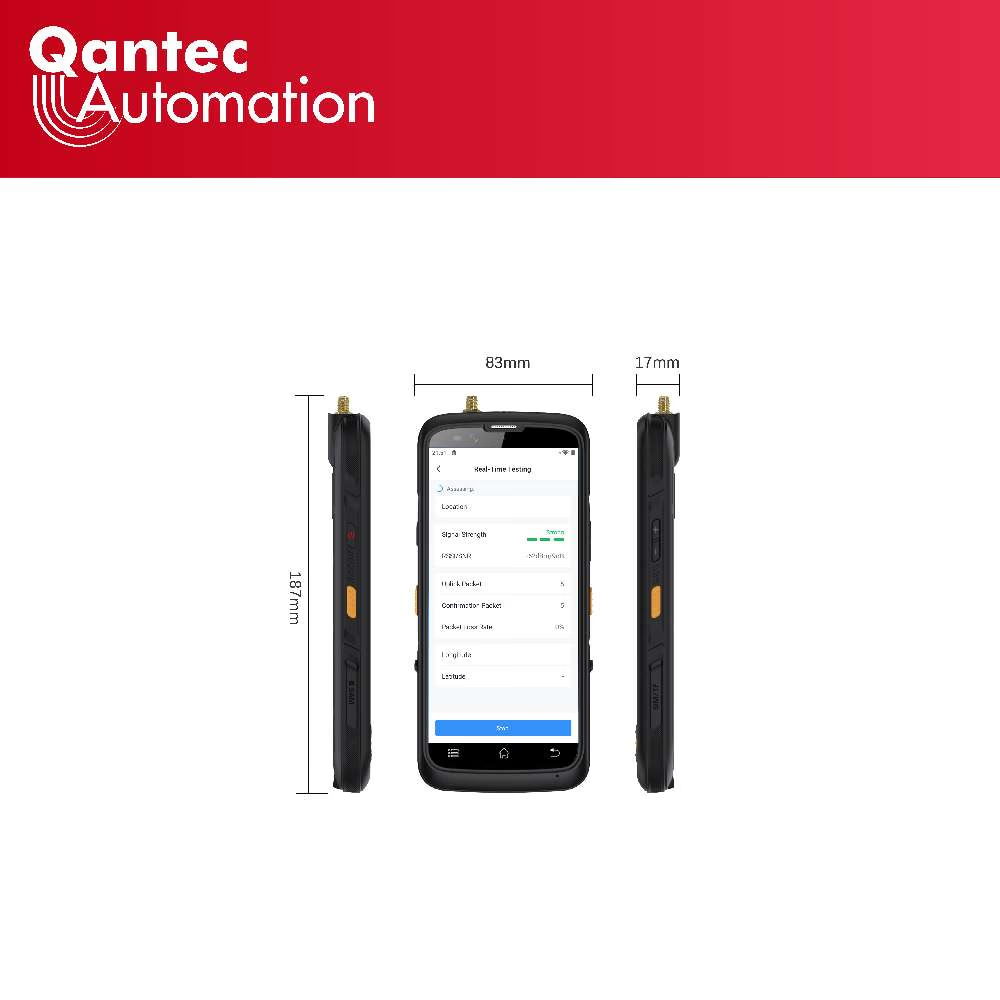
A LoRaWAN field tester is a portable network device that measures RSSI, SNR and packet-loss rate between a gateway and a node before sensors are permanently mounted, and it is among the first IoT product accessories an integrator reaches for on site. The Milesight FT101 is a LoRaWAN field tester that runs a single-channel Semtech SX1262 module on an octa-core Android platform behind a 5.72-inch touchscreen, logging up to eight global frequency plans — AU915, AS923, US915, KR920, IN865, EU868, RU864 and CN470 — through interchangeable external antennas. It records GNSS coordinates against each reading for outdoor coverage mapping, exports reports over USB Type-C, and delivers up to 8 hours of active testing with roughly 7 days standby. A reliable LoRaWAN field tester removes guesswork before any permanent mount. Because this LoRaWAN field tester is compatible with any standard LoRaWAN field gateway, it doubles as a commissioning tool for sites you intend to provision with a semi-industrial or outdoor gateway.
[browse the LoRaWAN gateways range](#) [Link to: LoRaWAN Gateway Sub-Category Page]
Milesight GA01 External Antenna
The Milesight GA01 is an omnidirectional fibreglass LoRaWAN antenna supplied as a kit with a 1-metre coaxial cable and N-type or SMA-to-N (S-N) connectors, and it is the most-specified RF item among these IoT product accessories and a strong candidate for the best LoRaWAN antenna on a typical Australian site. For most metropolitan rollouts the 60 cm unit is the pragmatic answer to "what is the best LoRaWAN antenna for this site"; the 130 cm unit suits flat regional links where line of sight is clear, and it remains the best LoRaWAN antenna where a long, clear path rewards higher gain. Choosing the best LoRaWAN antenna is mostly a question of mounting height and line of sight. Variant specifications are tabulated below.
| Variant | Length | Gain | Frequency Band | Connector |
|---|---|---|---|---|
| FNN600 / FSN600 | 60 cm | 4–5 dBi | 860–928 MHz | N-type / SMA-to-N |
| FNN1300 / FSN1300 | 130 cm | 8 dBi (860–868 MHz) / 8.5 dBi (902–928 MHz) | 860–928 MHz | N-type / SMA-to-N |
The 130 cm variant covers the Australian 915 MHz band, mounts to the UG56, UG65, UG65H and UG67 gateways, and is weather-rated for rooftop and mast installation; on a long rural link it is frequently the best LoRaWAN antenna in the range. When you compare the best LoRaWAN antenna options, weigh mounting height and line of sight ahead of raw dBi. The full specification is published on the Milesight product portal.
[Outbound: official Milesight GA01 datasheet — insert verified URL, milesight.com]
IoT Solar Panel and Backup Power Accessories
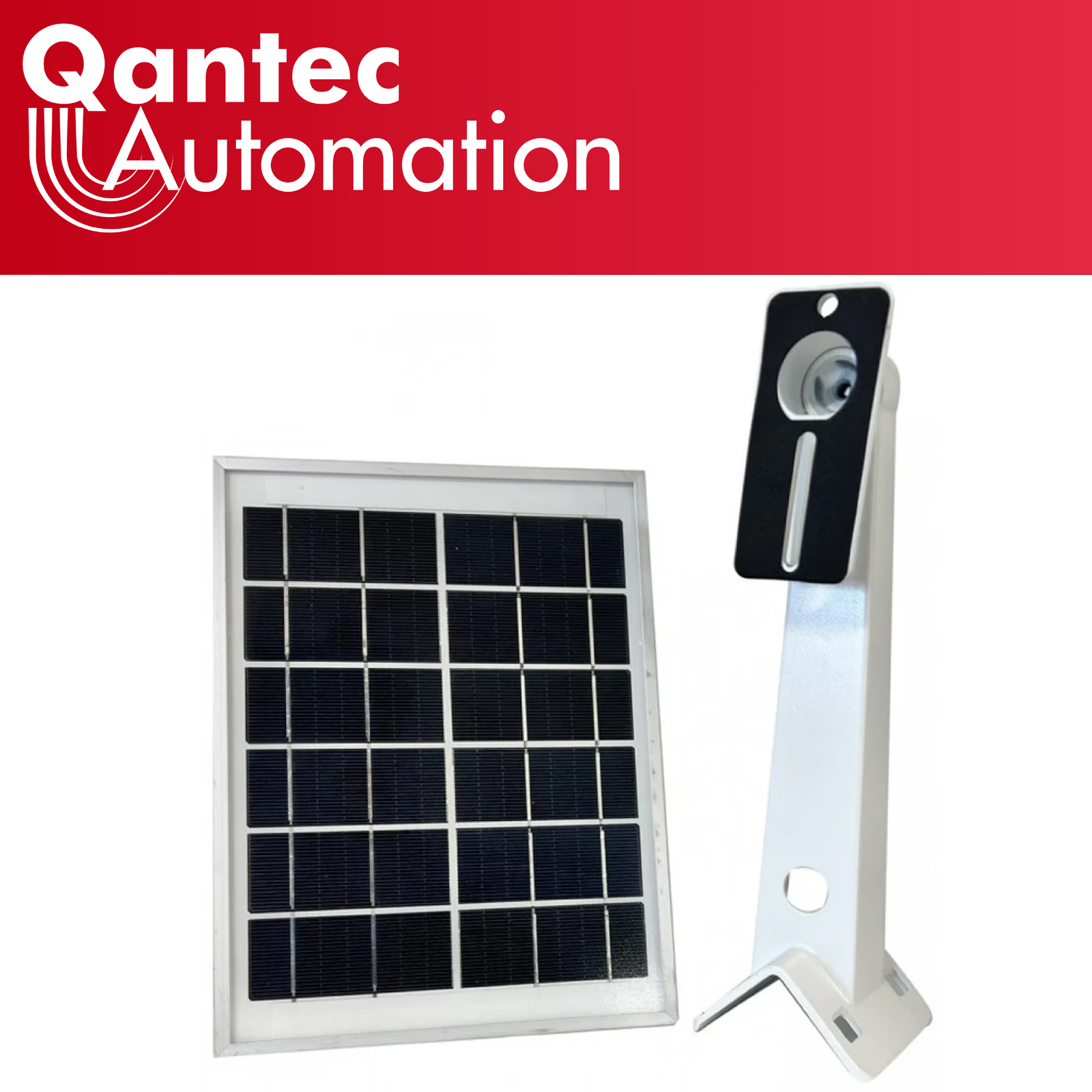
An IoT solar panel is a photovoltaic module that sustains a remote node where mains power is impractical, regulating its own charge to protect the downstream battery. Qantec stocks two ratings — a 5 W panel at 19.5% conversion efficiency for controller duty and a 45 W IP67 module at 20.37% efficiency for camera-class loads — each carrying integrated overcharge, short-circuit and reverse-current protection. A correctly sized IoT solar panel removes scheduled battery-swap truck-rolls, the dominant lifecycle cost on dispersed outdoor estates, and solar charging units are the IoT product accessories most often undersized at design time. The two ratings compare as follows.
| Model | Wattage | Efficiency | Voc / Isc | Dimensions (mm) | Target Device |
|---|---|---|---|---|---|
| Milesight CSOX (ACC-SOPAN) | 5 W | 19.5% | 17.56 V / 0.28 A (max) | 245 × 185 × 17 | UC501 / UC511 controllers |
| Milesight S45 | 45 W | 20.37% | 18.44 V / 3.01 A | 580 × 385 × 69 | 4G Sensing Camera platform |
Note: CSOX figures are maximum supply voltage and current; S45 figures are open-circuit voltage (Voc) and short-circuit current (Isc).
Milesight CSOX Solar Panel
The Milesight CSOX (ACC-SOPAN) is a 5 W monocrystalline solar panel for IoT controllers in the UC501 and UC511 series, with a maximum power of 10.12 W, maximum current of 0.28 A and a maximum supply voltage of 17.56 V. Conversion efficiency reaches 19.5%, and this IoT solar panel carries overcharge, short-circuit and reverse-current protection across a –40 °C to +85 °C operating range. It measures 245 × 185 × 17 mm at 0.6 kg, and it supplements the controller's integrated cell when application duty cycles exceed the on-board harvest. This 5 W IoT solar panel sits among the controller-class IoT product accessories Qantec stocks. It pairs with the multi-interface field controllers it is designed to power.
[view the IoT controllers range](#) [Link to: IOT Controllers Sub-Category Page]
Milesight S45 Solar Panel Module
The Milesight S45 is a 45 W IP67 monocrystalline IoT solar panel for outdoor sensing-camera workloads, rated at 20.37% module efficiency with an open-circuit voltage (Voc) of 18.44 V, short-circuit current (Isc) of 3.01 A, and a maximum-power point of 15.93 V / 2.82 A. This IoT solar panel ships with an MC4 connector and an integrated voltage regulator, measures 580 × 385 × 69 mm at 4.2 kg, and anchors to a mast for off-grid duty. As the camera-class member of these IoT product accessories, the S45 is the matched solar panel for IoT deployments built around the 4G Sensing Camera platform.
[see the camera range](#) [Link to: Camera Main Category Page]
Milesight UPS01 Power Supply
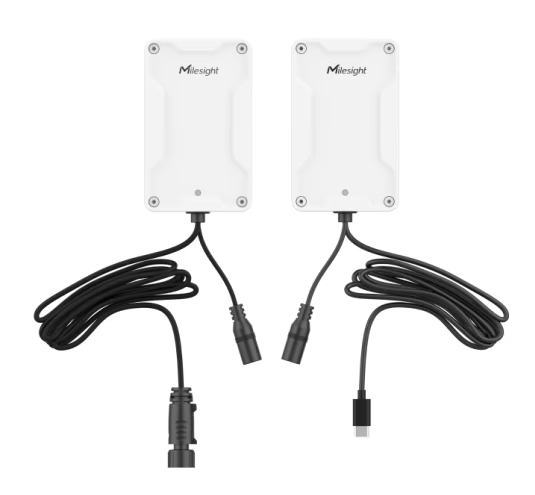
The Milesight UPS01 is a 12,000 mAh uninterruptible power supply and one of the most field-deployed IoT product accessories in this range, delivering up to 32 hours of backup with IP67 and IK08 protection. A resistive heating film keeps the cell operational in cold conditions, while Type-C and M12 connectors support plug-and-play integration with gateways, routers and sensing cameras. Tricolour indicators and internal logic report charge state, and on Milesight devices these IoT product accessories relay remote power-outage alarms. It mounts to a wall, pole, desktop or 35 mm DIN rail in a 96 × 60 × 45 mm aluminium housing.
PT100 Probe and Configuration Tool Accessories
A PT100 probe is a platinum resistance-temperature detector whose resistance rises predictably with temperature in accordance with DIN/EN 60751, giving a controller a calibrated measurement input. The Milesight PT-100 Probes are Class A, Class B and A-class food-grade platinum RTD elements to DIN/EN 60751 (catalogue SKUs SP11-A05-500-150, SP11-AF10-125-150 and SP11-B05-125-200), terminating into the TS301 single-channel or TS302 dual-channel LoRaWAN transmitter. They support cold-chain, plant-room and Legionella-compliance monitoring with HACCP and 21 CFR Part 11 record integrity. Specify these IoT product accessories alongside the environmental monitoring range they feed, and remember that these IoT product accessories carry the record integrity a compliance audit checks.
[browse the environmental monitoring range](#) [Link to: Environmental Sensors Sub-Category Page]
Milesight SCT01 Configuration Tool
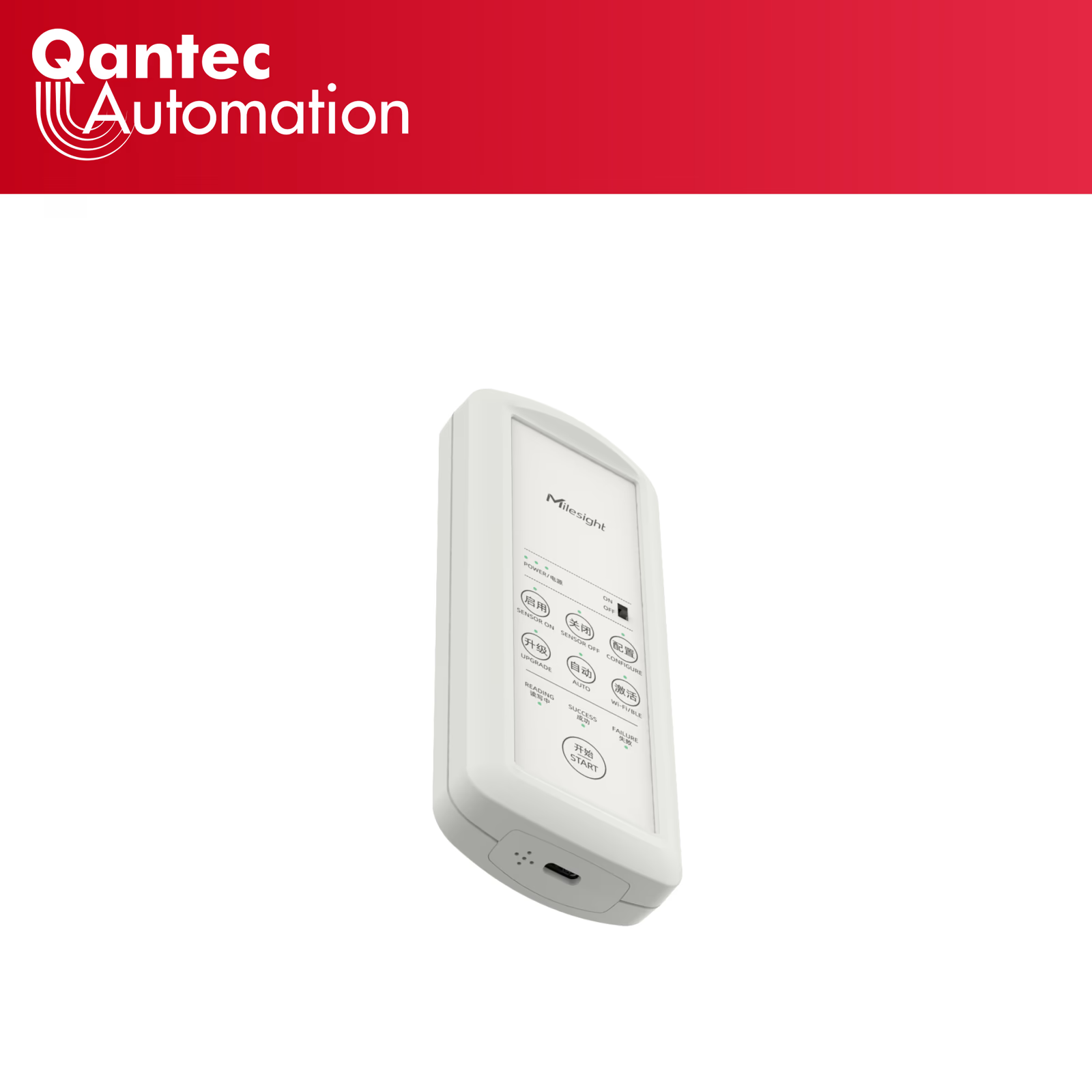
Among the commissioning IoT product accessories, the Milesight SCT01 is a portable NFC reader/writer that configures Milesight sensors on site at a stated >99.9% transfer success rate, eliminating the alignment failures common to phone-based NFC. It operates at 13.56 MHz over ISO/IEC 14443A with a 1–3 cm read distance, holds 16 MB of memory for up to 50 configuration templates plus one firmware file for bulk upgrades, and runs ~6 hours on a 2,000 mAh cell via USB Type-C. Bluetooth 4.0 (BLE) handles template import and log export from the ToolBox app. For large fleets, these IoT product accessories cut per-device commissioning time substantially.
Air Differential Pressure Switch Accessories
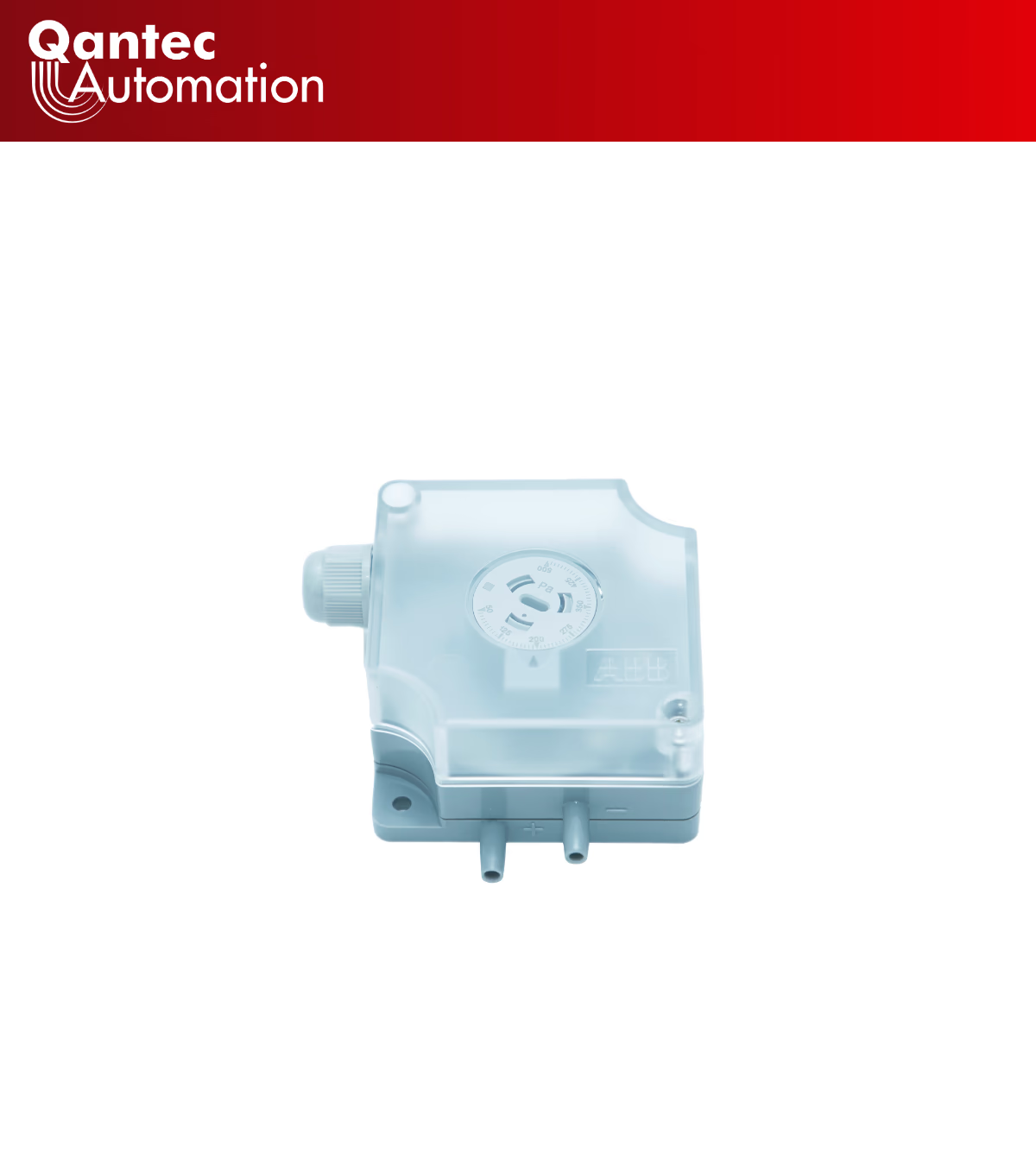
An air differential pressure switch is a diaphragm-actuated proving device that converts a pressure difference across a fan, filter or damper into a switched status contact for a building controller. The ABB Cylon CLS-APS-10 and CLS-APS-AC (ABB part 2TYZ310401R0004) provide this air differential pressure switch function as a field accessory, wiring into a universal or digital input on a Cylon controller to drive filter-blockage alarms and fan-proving logic under AS 1668.2 mechanical ventilation strategies. The air differential pressure switch is fundamental to dirty-filter detection and airflow verification in any compliant air-handling sequence, and it is one of the most widely fitted IoT product accessories in a mechanical-services panel.
[FALLBACK TRIGGERED: Abdullah/Sufyan please insert verified manufacturer datasheet parameters for ABB Cylon CLS-APS-10 / CLS-APS-AC — set-point range (Pa), differential dead-band, switch contact rating (SPDT, V/A), and electrical supply requirement — sourced from the official ABB datasheet, as exact values are not published on the public ABB product page]
ABB Cylon Power and Mounting Accessories
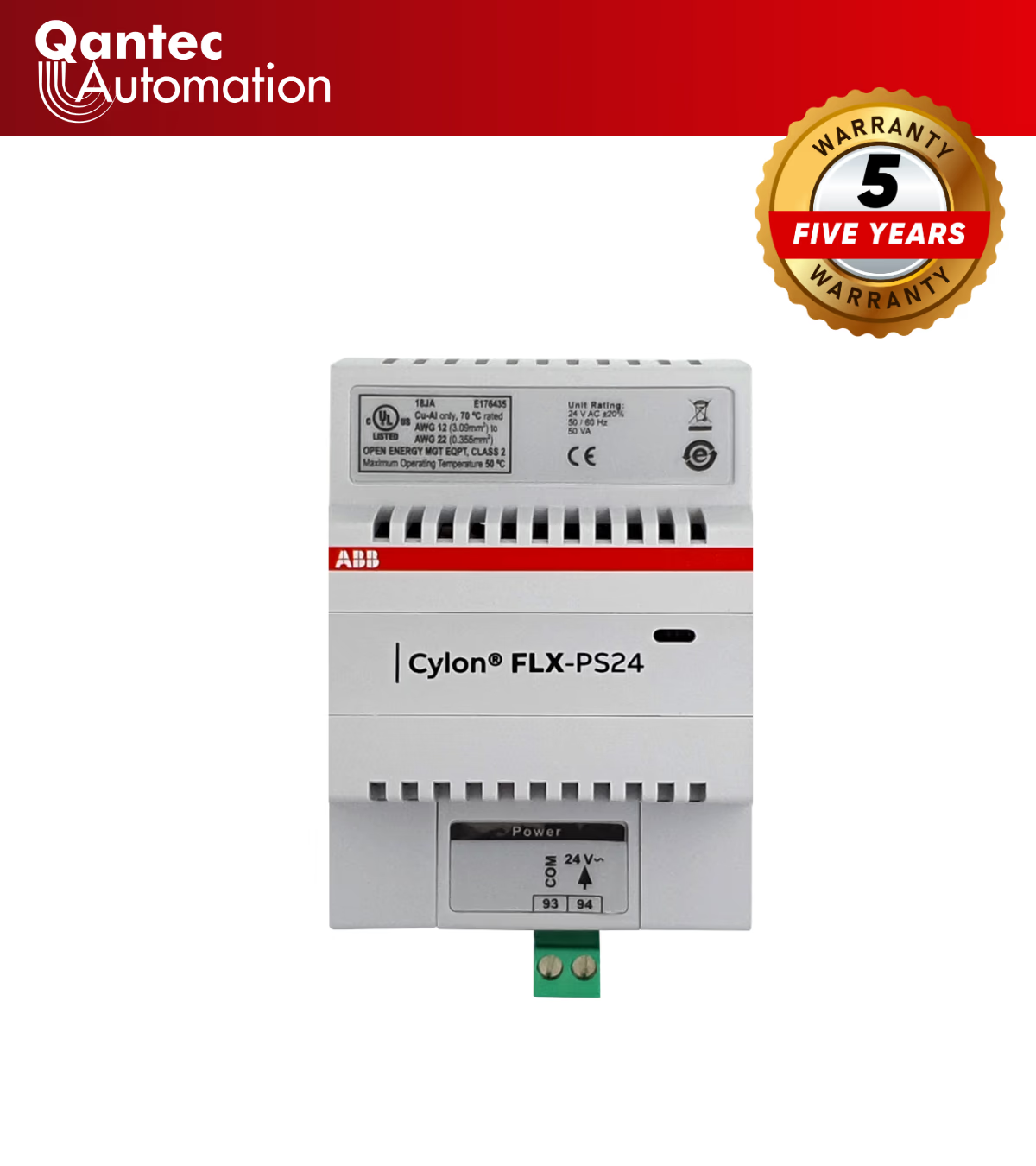
Field-level building automation devices typically draw from a 24V DIN rail power supply, or a 24v ac power supply din rail arrangement for legacy AC actuators, mounted in the same switchboard as the controller. The ABB FLX-PS24 (1M101111) is a DIN rail power supply module that delivers a regulated 20 V DC rail — rated to 20 W per module — to FLX (Field Level eXpansion) I/O modules and external field devices via the FLX-RMC. Beyond supplying power, it carries inter-module communications from a CBXi controller to extend point capacity to 96 points and to permit remote, multi-row mounting of expansion hardware, and it sits among the ABB Cylon IoT product accessories Qantec holds in Australian stock. These ABB power IoT product accessories are documented in datasheet DS0130, published by ABB at the Cylon resource library.
[Outbound: ABB Cylon DS0130 datasheet — insert verified URL, cylon.com]
ABB FLX-RMC and FLX-bus Interconnect
The ABB FLX-RMC (1S9NT104) is the Remote Module Connector that lets a CBXi or CBX controller and its FLX modules mount in single or multiple rows, working with the FLX-PS24 to power remote field devices. The ABB FLX-bus Interconnect (1S9NT101) is the physical link that carries power and inter-module data along the FLX-bus between the main controller and each expansion module. Together they let integrators distribute flexible input/output expansion without re-routing every field cable to a central panel, and both are core IoT product accessories for any ABB Cylon panel build.
[see the I/O expansion modules range](#) [Link to: I/O Expansion Modules Sub-Category Page]
ABB Mounting Flange MF7 (1S9SW126)
The ABB Mounting Flange MF7 (1S9SW126) is the mechanical mounting flange for installing Cylon controllers and modules into an enclosure or onto a backplane. It belongs to the same 1S9-series hardware family as the FLX-RMC and FLX-bus interconnect, and it completes the mechanical IoT product accessories needed to seat a Cylon stack, providing a standardised fixing interface so the controller stack seats cleanly alongside the BACnet field controllers it supports.
[browse BACnet controllers](#) [Link to: BACnet Controllers Sub-Category Page]
IoT Product Accessories and Australian Compliance
Australian deployment of IoT product accessories is governed by a defined stack of building, energy and radio-communications standards rather than by general best practice. Under NABERS (National Australian Built Environment Rating System), the integrity of metering and environmental data depends on the reliability of the power and sensing accessories feeding it; a logged gap from a flat battery degrades the rating period. NCC (National Construction Code) Section J.9 circuit sub-metering relies on continuous, accurately powered field devices, which is where the FLX-PS24 rail and UPS01 backup carry compliance weight. AS 1668.2 ventilation sequences depend directly on a functioning air differential pressure switch for fan-proving and filter alarms. Wireless accessories must also operate within the ACMA LIPD Class Licence on AU915, and any solar-powered outdoor asset should be installed in line with WHS Act 2011 working-at-height controls. Specifying IoT product accessories against these frameworks is what separates a passing audit from a flagged one. These obligations connect the accessories range to the broader building automation portfolio and the wider IoT sensing range.
[visit the building automation category](#) [Link to: Building Automation Main Category Page]
[explore the IoT sensing range](#) [Link to: IoT Sensors & Devices Main Category Page]
Why Specify Qantec for IoT Product Accessories
Cybersecurity and Firmware Integrity Layers
These IoT product accessories sit on the same cyber-physical attack surface as the controllers they serve, so they belong inside a layered defence. At the network layer, segregate field devices onto a dedicated VLAN and tunnel any remote engineering access over a VPN rather than exposing controller ports to the public internet. At the access layer, enforce per-user credentials and role-based controls on the supervisory platform, paired with the BMS supervisory software and licences that govern them. Maintain firmware integrity by validating signed images before flashing — the SCT01 stores a single verified firmware file precisely to prevent unverified payloads — and physically secure switchboards housing the FLX-PS24 and ABB Cylon hardware. Encrypt sensor payloads end to end so intercepted LoRaWAN traffic cannot be replayed.
[review BMS software and licences](#) [Link to: BMS Software & Licences Sub-Category Page]
IoT Product Accessories — Technical FAQ
Each answer below reflects how Qantec engineers specify these IoT product accessories on Australian sites, from antenna gain to power and frequency planning.
What antenna gain suits an Australian LoRaWAN deployment?
For most Australian sites, a 4–5 dBi omnidirectional antenna such as the GA01 60 cm is the correct default, because urban and suburban paths benefit from a broad radiation pattern over raw gain. Reserve 8 dBi-plus only for flat regional links with clear line of sight, and always raise the antenna before increasing gain — mounting height improves Fresnel-zone clearance more reliably than a higher dBi figure, and the LIPD Class Licence caps your effective radiated power regardless. In practice the best LoRaWAN antenna for a site is rarely the highest-gain unit. When you choose between these IoT product accessories, treat height and line of sight as the primary levers and dBi as secondary, because the best LoRaWAN antenna is the one mounted high with clear line of sight.
How does voltage drop affect remote FLX expansion-module cabling distance?
Voltage drop sets the practical limit on how far an FLX expansion module can sit from its source on the FLX-bus, because the 20 V DC rail must remain within the modules' tolerance at full load. Longer runs and thinner conductors increase resistive loss, so an FLX-PS24 placed local to a remote cluster — rather than back-feeding from the controller — preserves rail voltage. ABB specifies copper or copper-clad aluminium 70 °C conductors and a 20 W per-module power ceiling to keep the calculation honest for these IoT product accessories.
What is the difference between AU915 and AS923 on the FT101 field tester?
AU915 and AS923 are distinct regional frequency plans, and the FT101 LoRaWAN field tester must be set to the plan your gateway uses or the join will fail. Australian LoRaWAN networks operate on AU915 (915–928 MHz) under the ACMA LIPD Class Licence, whereas AS923 is used across parts of Asia-Pacific on a different channel scheme. Confirm the gateway's plan first, then match the LoRaWAN field tester and its antenna before running any signal evaluation; these IoT product accessories must agree on the plan.
Why choose a 24V DIN rail power supply over a plugpack for field devices?
A 24V DIN rail power supply mounts inside the switchboard on the same rail as the controller, giving you a serviceable, terminal-wired source instead of a plugpack on an accessible socket. DIN-mounted supplies offer higher continuous reliability, cleaner cable management and protection against accidental disconnection — material advantages when the load feeds NABERS-reported metering or AS 1668.2 fan-proving logic. The ABB FLX-PS24 follows this form factor while supplying the FLX I/O chain directly, the workhorse among the ABB power IoT product accessories.
Footer CTA Section
Stocked, datasheet-verified IoT product accessories, dispatched from Australia — here is how to close out your accessory list.
Source Every IoT Product Accessory From One Australian Supplier
From a LoRaWAN field tester and antennas to solar panels, probes and ABB Cylon field power hardware, Qantec Automation holds the supporting IoT product accessories your deployment depends on — in local stock, datasheet-verified, and backed by engineers who specify them daily. Send us your controller, gateway or sensor model and we will confirm the exact IoT product accessory before you commit a purchase order.
[Shop All Accessories] [Request Trade Pricing] [Talk to an Engineer]
Extended FAQ
How do you run a LoRaWAN coverage survey before mounting sensors?
Run a coverage survey by carrying a LoRaWAN field tester through every planned sensor location and logging RSSI, SNR and packet-loss rate against the gateway before any hardware is fixed. The Milesight FT101 transmits packets across multiple spreading factors so you can confirm a usable link margin at the weakest point, and its GNSS log converts each reading into a coverage map. Fix sensors only where SNR stays comfortably above the demodulation floor.
*[DEVELOPER NOTE: Sourced from high-visibility PAA. Sufyan, embed this verified video URL: https://www.youtube.com/watch?v=_a3MW9Vs3xU and apply VideoObject Schema per technical standards]*
What coaxial cable length and connector type minimise signal loss on the GA01 antenna?
Keep the coaxial run as short as practical and use the supplied N-type termination, because every additional metre of 50-ohm coax adds insertion loss that erodes the GA01's 4–8.5 dBi gain. The antenna ships with a 1-metre cable and N-male or SMA-to-N connectors; where the gateway must sit far from the mast, relocate the gateway rather than splicing in longer coax. Threaded N-type connectors also resist moisture ingress far better than push-fit types in exposed positions.
How do I calculate the right IoT solar panel size for a remote node?
Size an IoT solar panel by first totalling the node's daily energy draw in watt-hours, then specifying a panel and battery that cover at least three days of autonomy at worst-case winter irradiance. A practical rule is to oversize panel output to roughly 1.5× daily consumption and to size a lithium battery at no more than 80% depth of discharge. In southern Australia, base the calculation on June sun-hours rather than summer figures to avoid shoulder-season brown-outs.
Should an air differential pressure switch be wired normally open or normally closed?
Wire an air differential pressure switch normally open for fan-proving, so its contacts make only once airflow generates the set differential, and normally closed where you need a fail-safe filter-blockage or loss-of-airflow alarm. The switch presents volt-free SPDT contacts that land on a digital input, and the controller — not the switch — interprets the resulting state. Set the trip point just above the proven-flow pressure to prevent nuisance trips on a variable-speed supply fan.
Can a third-party 24V DIN rail power supply replace the ABB FLX-PS24?
No — a generic 24V DIN rail power supply cannot replace the ABB FLX-PS24, because the FLX-PS24 also carries the inter-module communications that extend a Cylon controller's point count and enable remote module mounting. A standard 24v ac power supply din rail unit will energise discrete field devices, but only the FLX-PS24 integrates with the FLX-bus to grow a CBXi controller to 96 points. Reserve third-party supplies for ancillary loads and use the FLX-PS24 for the FLX chain itself.
What is the difference between IP65 and IP67 ratings on this hardware?
IP65 means the enclosure is dust-tight and withstands low-pressure water jets, while IP67 means it is dust-tight and survives temporary immersion to one metre for thirty minutes. The Milesight UPS01 and S45 solar panel carry IP67 for fully exposed outdoor duty, whereas jet-rated IP65 hardware suits sheltered or eaves-mounted positions. Match the rating to real splash and pooling risk rather than treating "outdoor" as a single category.
When should I use the SCT01 instead of the ToolBox phone app for NFC configuration?
Use the SCT01 when commissioning sensors in bulk or in the field, and reserve the ToolBox phone app for occasional one-off changes, because the SCT01's expanded NFC area delivers a transfer success rate above 99.9% that phones routinely miss through misalignment. It stores up to 50 configuration templates and one firmware file, so a technician can flash an entire fleet without a phone or network connection. Gloved, rooftop and cold-store commissioning is where it earns its place.
How often does the Milesight UPS01 battery need replacement, and what shortens its life?
Plan to replace the UPS01's lithium cell on a scheduled maintenance cycle rather than on failure, because rechargeable lithium capacity fades with charge cycles and is accelerated by sustained heat. Australian rooftop and plant-room temperatures are the dominant ageing factor, so shade the unit where possible and avoid repeated deep discharges. On Milesight devices the UPS01 reports charge state and outage alarms remotely, letting you flag a fading cell before it drops the connected load.